
Common Symptoms
- Pain and tenderness over the medial epicondyle on the inner side of the elbow
- Discomfort that worsens with resisted wrist flexion and forearm pronation
- Weak grip and difficulty carrying objects due to pain provoked at the common flexor origin
- Aching that may radiate down the medial forearm toward the wrist during activity
- Intermittent numbness or tingling in the ring and little fingers from concurrent ulnar nerve irritation
- Morning stiffness at the medial elbow that improves after a brief warm-up period
Golfer's Elbow (Medial Epicondylitis): AI-Powered MRI & X-ray Analysis
AI-powered golfer's elbow analysis on MRI. See how common flexor tendon tears, medial epicondyle edema, and ulnar nerve involvement appear on imaging. 4 AI models explain medial epicondylitis findings and associated injuries.
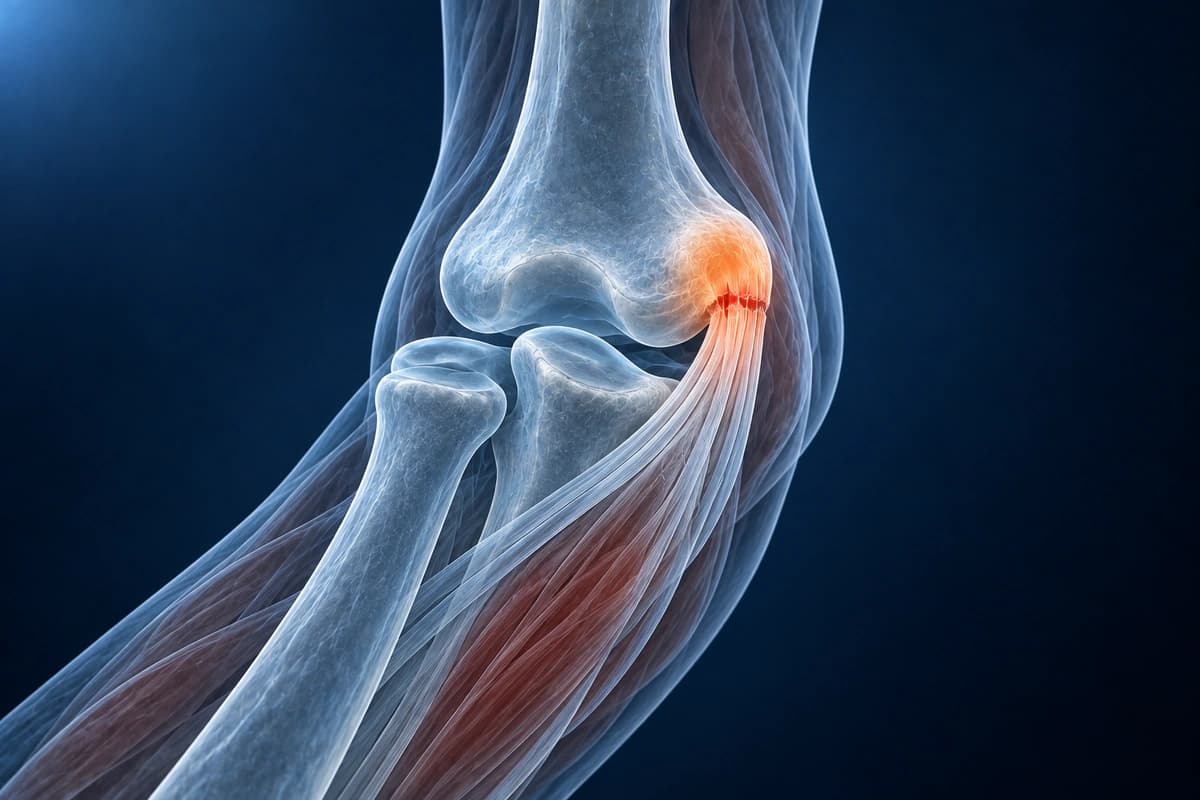
Medial epicondylitis, commonly known as golfer's elbow, is an overuse tendinopathy affecting the common flexor-pronator tendon origin at the medial epicondyle of the humerus. Despite its nickname, this condition frequently affects athletes in racquet sports, throwing disciplines, and workers performing repetitive gripping or wrist flexion. MRI is the preferred imaging modality for evaluating tendon integrity, distinguishing partial from full-thickness tears, and identifying associated ulnar collateral ligament or ulnar nerve pathology. AI can help explain report terms about tendons and tears, but a clinician must confirm the findings and discuss treatment with you.
What We Look For on Imaging
- Thickening and increased T2 signal within the common flexor tendon origin
- Partial-thickness tearing at the tendon footprint on the medial epicondyle
- Full-thickness tendon tears with retraction and gap measurement
- Periosteal edema and bone marrow signal change at the medial epicondyle
- Associated ulnar collateral ligament injury or thickening
- Ulnar nerve enlargement or subluxation suggesting concurrent cubital tunnel syndrome
Frequently Asked Questions
Which tendons are affected in medial epicondylitis?
Medial epicondylitis involves degenerative tendinopathy of the common flexor–pronator tendon origin at the medial epicondyle. The flexor carpi radialis and pronator teres are most frequently and severely affected, as they bear the highest tensile load during activities that combine wrist flexion and forearm pronation such as a golf swing, throwing, or racket sports. The palmaris longus, flexor carpi ulnaris, and flexor digitorum superficialis origins can also be involved. Histopathology shows angiofibroblastic hyperplasia with disorganized collagen, immature fibroblasts, and vascular proliferation, identical to the changes seen in lateral epicondylitis.
What does the moving valgus stress test assess in medial elbow pain?
The moving valgus stress test assesses pain arising from the ulnar collateral ligament, not the common flexor tendon. An examiner applies valgus stress while extending the elbow; reproduction of ligament pain, greatest between 120 and 70 degrees of flexion, supports ligament involvement. It is not a stand-alone diagnosis of medial epicondylitis.
Are corticosteroid injections effective for medial epicondylitis?
Corticosteroid injection into the common flexor–pronator tendon origin can provide short-term pain relief of 4 to 8 weeks but has not been shown to improve long-term outcomes compared to physical therapy alone. Injection must be performed carefully to avoid inadvertent UCL infiltration, which could weaken the ligament in throwing athletes, and to avoid intraneural injection near the ulnar nerve. Given risks of tendon attenuation and cartilage toxicity, repeated injections are discouraged. Platelet-rich plasma injection has shown promise in small trials as a biologically active alternative that may promote tendon healing without the catabolic effects of corticosteroids.
Sources
- Ciccotti MC, Schwartz MA, Ciccotti MG. Diagnosis and treatment of medial epicondylitis of the elbow. Clin Sports Med. 2004;23(4):693-705.
- Amin NH, Kumar NS, Schickendantz MS. Medial epicondylitis: evaluation and management. J Am Acad Orthop Surg. 2015;23(6):348-355.
- O'Driscoll SW, Lawton RL, Smith AM. The "moving valgus stress test" for medial collateral ligament tears of the elbow. Am J Sports Med. 2005;33(2):231-239.
- Stahl S, Kaufman T. The efficacy of an injection of steroids for medial epicondylitis. A prospective study of sixty elbows. J Bone Joint Surg Am. 1997;79(11):1648-1652.
Related Articles
Learn about lateral epicondylitis natural healing rates, physical therapy options, and when surgical intervention is needed.
Understand common elbow conditions including tennis elbow, golfer's elbow, UCL tears, radial head fractures, and OCD lesions.
Compare MRI and ultrasound for tennis elbow, golfer's elbow, UCL tears, and biceps injuries — strengths, limitations, cost, and dynamic assessment.
Get an educational explanation of imaging terms related to Golfer's Elbow
Upload your MRI or X-ray DICOM files for private, AI-powered analysis. 4 models analyze independently — raw scan files stay in your browser.
Upload & AnalyzeMedical Disclaimer: This page is for informational and educational purposes only. It does not constitute medical advice, diagnosis, or treatment. AI-generated analysis may contain errors. Always consult a qualified healthcare professional for medical decisions. Full Disclaimer