
Common Symptoms
- Sudden sharp pain at the front of the elbow during heavy lifting or eccentric load
- Audible or felt pop at the moment of injury
- Visible deformity — biceps muscle belly retracts upward toward the shoulder (reverse Popeye sign)
- Weakness with elbow flexion and, critically, with forearm supination (turning palm up)
- Bruising and swelling over the antecubital fossa (front of the elbow crease)
- Palpable gap or defect in the antecubital fossa where the tendon normally inserts
Distal Biceps Rupture on MRI: AI-Powered Imaging Analysis
AI-powered distal biceps tendon rupture imaging analysis on elbow MRI. Reverse Popeye sign, complete vs partial tears, retraction distance, and how these findings appear on imaging.
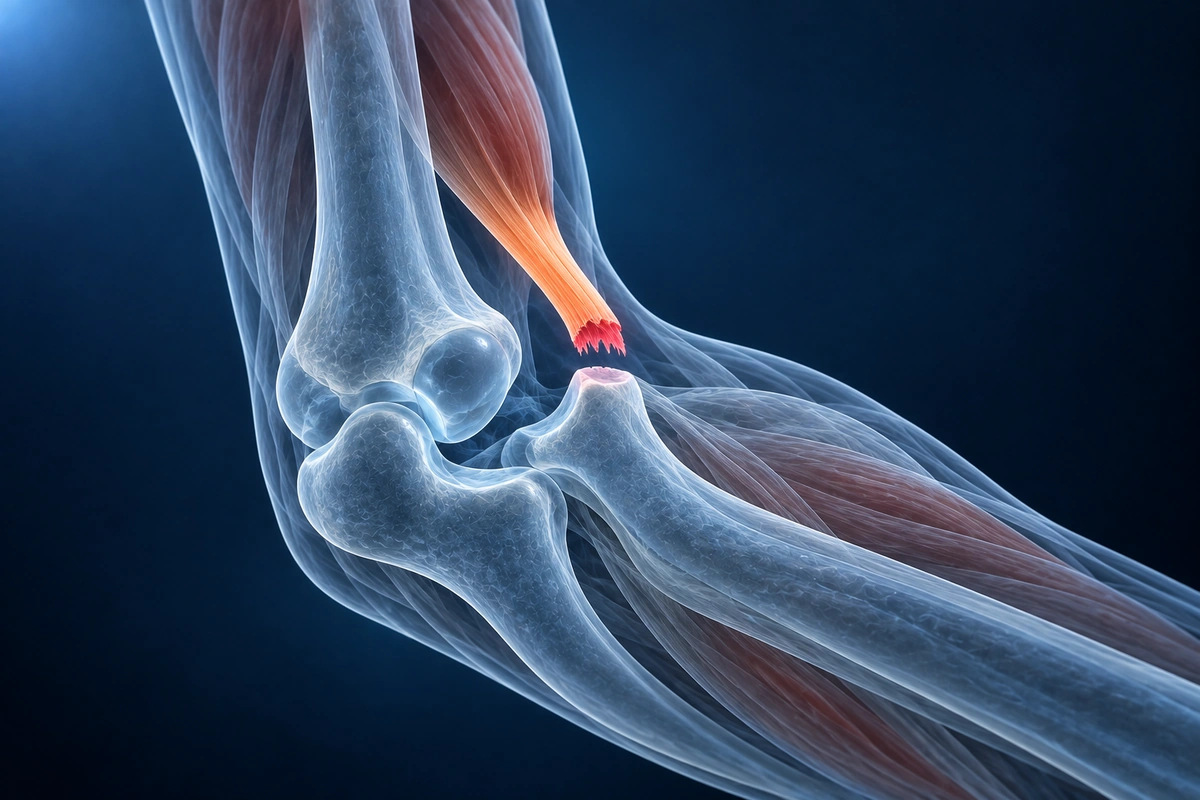
Distal biceps tendon rupture is most common in middle-aged men in their 40s and 50s during heavy lifting or a sudden eccentric load on a flexed elbow — catching a heavy falling object, a missed deadlift, or a stumble while carrying weight. The mechanism is an unexpected forced extension of the elbow while the biceps is actively contracting. Unlike proximal biceps tears at the shoulder, distal ruptures at the radial tuberosity cause substantial functional deficits: up to 40–50% loss of supination strength and approximately 30% loss of elbow flexion strength.
Timing is critical. Surgical repair within 3–4 weeks of injury dramatically improves outcomes — the tendon stump is still mobile and can be retrieved and reattached to the radial tuberosity with minimal dissection. After 3–4 weeks, the tendon retracts further and scars into the surrounding tissues, making repair significantly more difficult and requiring graft reconstruction rather than direct repair. Emergency department physicians frequently miss this injury; if you felt a pop in the front of your elbow during exertion, seek orthopedic evaluation promptly.
What We Look For on Imaging
- Complete distal biceps tendon discontinuity at or near the radial tuberosity insertion on sagittal and axial MRI
- Retracted tendon stump seen as a rounded low-signal mass proximal to the antecubital fossa, often surrounded by hematoma
- Hematoma and fluid in the cubital fossa at the site of the tear
- Surrounding muscle edema and peritendinous fluid on T2-weighted and STIR sequences
- Bicipital aponeurosis (lacertus fibrosus) integrity assessment — an intact aponeurosis limits retraction and keeps the tendon stump accessible; a torn aponeurosis allows greater proximal migration
- Partial tear: fiber attenuation with high T2 signal at the insertion but without complete discontinuity
- FABS view MRI (flexion-abduction-supination position) places the distal biceps tendon in plane with the imaging slice, improving visualization of the insertion and tear extent
Frequently Asked Questions
Do I need surgery for a distal biceps rupture?
If you want to fully recover supination strength, surgical repair is strongly recommended for complete tears in active individuals. Non-operative management results in a permanent 30–50% loss of supination strength and approximately 30% loss of flexion power. For most patients — anyone who lifts, works with tools, plays sports, or simply wants to turn a doorknob or open a jar without fatigue — that deficit is unacceptable. Elderly patients or those with significant comorbidities who accept a sedentary functional level may elect non-operative care, but this is the minority. For partial tears with intact fibers, conservative management with activity modification and physical therapy is a reasonable first-line approach.
How soon do I need surgery after a distal biceps rupture?
Ideally within 3–4 weeks of injury. In the acute phase, the tendon stump is mobile, the repair is straightforward, and outcomes are excellent — most patients recover full or near-full supination strength by 4–6 months. After 3–4 weeks, the tendon retracts and adheres to surrounding tissue with scar. Delayed repair beyond 6 weeks typically requires allograft or autograft reconstruction because direct reattachment is no longer possible, adding complexity and extending recovery. Do not delay orthopedic evaluation if you suspect this injury.
What happens if I choose not to have surgery?
Without surgical repair of a complete distal biceps rupture, you will have a permanent 30–50% deficit in forearm supination strength and approximately 30% reduction in elbow flexion strength. The cosmetic deformity — the biceps belly bunched up near the shoulder rather than filling the front of the arm — also persists. Over time, many patients develop fatigue and aching with repetitive activities like using a screwdriver, lifting groceries, or carrying boxes. The shoulder and rotator cuff compensate for the lost supination power, sometimes leading to secondary shoulder overuse problems. For truly sedentary individuals this may be tolerable; for anyone with physical demands at work or in daily life, the functional consequences are significant and long-lasting.
Related Articles
📖
How to Read an Elbow MRI: A Patient's Guide
📖Understand your elbow MRI report including UCL evaluation, epicondylitis findings, and OCD lesion staging.
Do You Need a 3T MRI for an Elbow Injury?
Learn when 3T elbow MRI can help for UCL tears, osteochondral lesions, tendon detail, and occult fractures, and when X-ray, ultrasound, or 1.5T MRI is enough.
Upload your imaging to check for Distal Biceps Rupture
Upload your MRI or X-ray DICOM files for private, AI-powered analysis. 4 models analyze independently — raw scan files stay in your browser.
Upload & AnalyzeMedical Disclaimer: This page is for informational and educational purposes only. It does not constitute medical advice, diagnosis, or treatment. AI-generated analysis may contain errors. Always consult a qualified healthcare professional for medical decisions. Full Disclaimer